
No products in the cart.

10
Feb
Feb
Tech Spotlight
Melling Oil Pump Upgrade Guide for LS
The factory LS oil pump suffers from cavitation above 6,200 RPM, which results in a drop in oil flow of nearly 1 GPM by 7,000 RPM, as well as introducing aeration into the oil. This can lead to oiling-related issues throughout the engine. Upgrading the oil pump is recommended any time there is cause to remove the front timing cover in order to improve oiling. This is especially important when adding power and rpm to a given combination.
Note that several different late-model GM vehicles contain a secondary oil pressure relief valve in the oil pan. This is used to accommodate the OEM high-volume oil pump and the large swings in oil demands for engines equipped with VVT and AFM. This relief begins to open at about 55psi of oil pressure and can limit oil pressure seen with a higher pressure aftermarket pump. This relief can be eliminated with the oil pan removed from the vehicle by removing it and installing an M14x1.5. This is not required when upgrading the oil pump, and the benefits of an aftermarket pump can still be appreciated without removing the secondary pressure relief. Extreme RPM and horsepower applications should consider this modification to maximize oil pressure. We do not recommend removing this bypass for engines using the 10355 oil pump unless combined with additional bearing clearance.
MELLING 10295
Stock volume, high pressure. OEM (LS3) 6.8gpm volume, +10psi pressure.
This is an acceptable replacement for the OEM LS3 oil pump in stock and mild to moderate naturally aspirated applications with no additional oil system demands (larger cooler, increased bearing clearance, turbo, etc). This pump is not suitable for VVT applications.
- Red spring (installed) – 70psi bypass
- Optional Blue spring – 60 psi bypass
- Optional Silver “COPO” spring – 85psi bypass
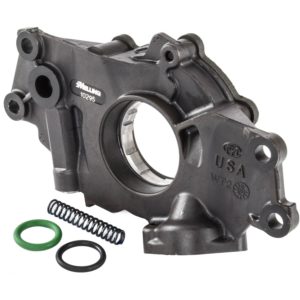
MELLING 10296
High volume, high pressure. 8gpm volume, +10psi pressure. Requires 6+ quart oil sump capacity.
We recommend this pump as our “go-to” upgrade for the OEM LS3 oil pump in naturally aspirated and power adder applications. This pump can provide some added oil volume for added oiling system demands such as external coolers, larger bearing clearances, turbochargers, etc. The added volume is also a benefit in maintaining solid oiling with significantly increased RPM. This pump is not suitable for VVT applications.
- Red spring (installed) – 70psi bypass
- Optional Blue spring – 60 psi bypass
- Optional Silver “COPO” spring – 85psi bypass
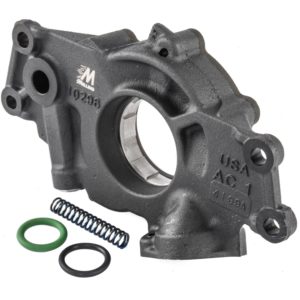
MELLING 10355
High volume, high pressure. 9.5gpm volume, +10psi pressure. Suitable for VVT and AFM. Requires 6+ quart oil sump capacity.
We recommend this pump as an upgrade for the OEM LS3 oil pump in applications with added oiling system demands such as large external oil coolers, larger bearing clearances, turbochargers, etc. This is also the recommended oil pump for extreme (8000+) rpm applications. We recommend this pump as a replacement for the OEM L99 oil pump in all VVT applications.
- Orange spring (installed) – 70psi bypass
- Optional Yellow spring – 60 psi bypass
- Optional Green spring – 80psi bypass
QUESTIONS?
We recognize these are general suggestions. Want to know what we recommend for your specific build? Just press that “Questions? Ask Us?” button in the bottom right-hand corner, and we will get back to you ASAP!

Did a complete DOD/AFM delete. My truck is a 2008 Silverado 5.3 flex. Installed new cam, lifters, gaskets, valle plate, cam bearings. Also removed the bypass in the oil pan, riveted the towers, and put a new oil tube pick up o-ring. Still having low oil pressure.
I think I must install a new pump but not sure, What’s the best oil pump for my setup? Thanks
A 10295 should work fine in that application. Low oil pressure issues are not necessarily always the result of a bad pump, you may have other issues at hand. I would check the oil and filter for any bearing material that might indicate if you have anything going away in the bottom end of the motor, as well as verify that the pickup tube doesn’t have an improper or pinched/damaged o-ring. Factory gauges are also not always accurate, so taking a manual pressure reading would be another reasonable verification to make before tearing back into the motor.
Thanks for your response.
I chat this morning with a person from this webpage and he suggested the following:
“I would put a 10296 or a 10355 either can be good”
James
“10295 is basically a stock
replacement, when you get a lot of miles on an engine and the bearings get a little wear, it is not a bad idea to add a little volume to help things a long.”
Can you please confirm?
I agree that as an engine wears, oil pressure will drop off a little as clearances widen. This does increase the demand for both pressure and volume some – all pumps are internally regulated to meet changing engine and oil conditions seen over the life of the engine. Upgrading to a high volume oil pump to solve an oil pressure issue assumed to be related to worn bearings is a short term solution – you need to correct the wear issue.
A 10296 is 18% more volume, the 10355 is 40% more volume that stock – they will work with a 6qt pan in truck applications at truck engine RPMs – GM sold them this way from the factor. For high performance, high rpm applications we like to see the high-volume pumps run with larger oil capacity setups. Without a more in depth conversation to better understand all the details of your particular combination, how you’re using it, and the specifics of your oil pressure situation it’s challenging to offer a solid diagnosis and recommendation to a problem that can a wide variety of causes.